
The World Is Buying New York: Why Foreign Capital Is Flooding into NYC Real Estate
On a crisp morning in March 2026, a Japanese real estate firm quietly closed on a six-story SoHo walk-up at 75 Thompson Street for $17 million. Three weeks later, the same buyer acquired a smaller commercial property at 684 Avenue of the Americas for $5.8 million. Neither deal made front-page news. Together, they were part of something much larger: a sustained, strategically deliberate reallocation of Japanese capital into New York City real estate that has been accelerating since early 2024 and shows no signs of slowing.
Japan’s Multibillion-Dollar Bet on New York’s Walk-Ups
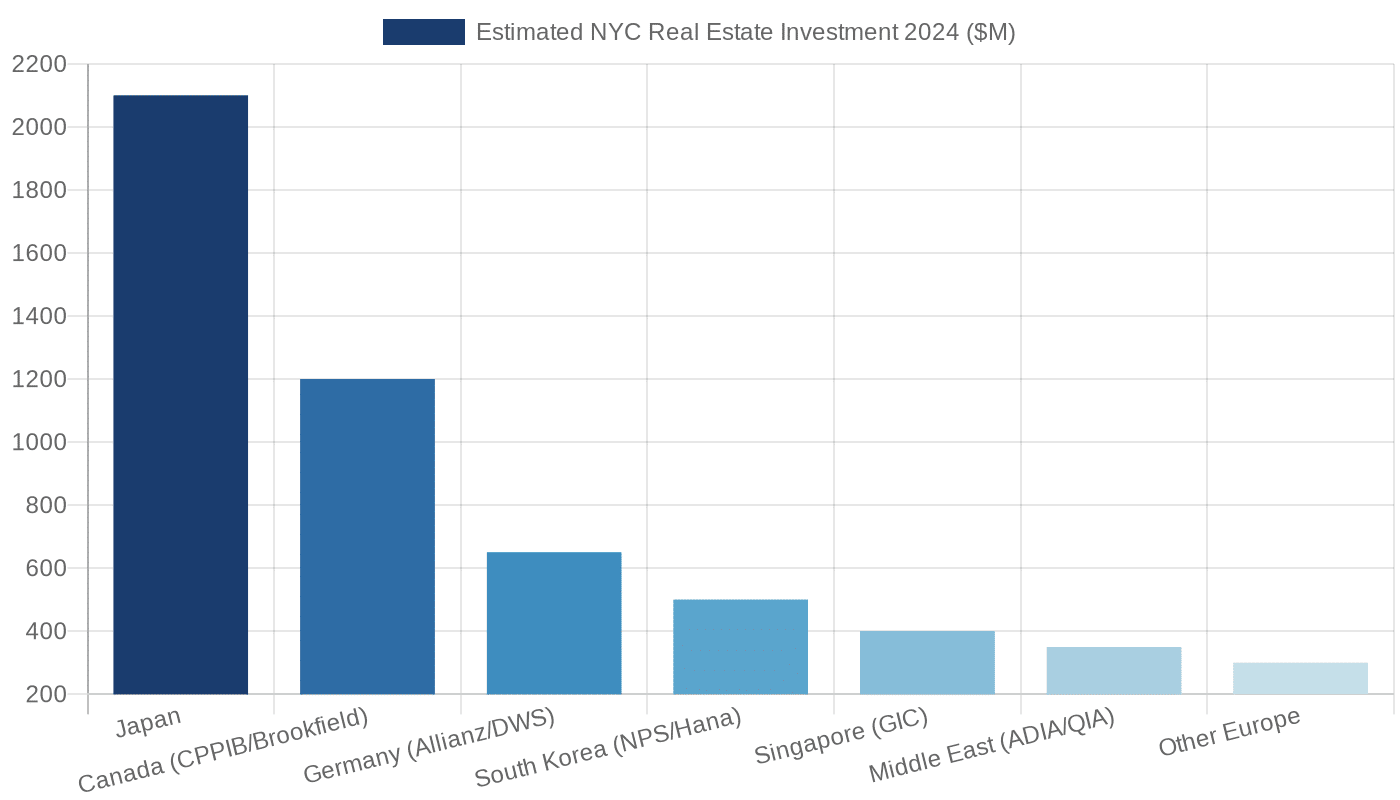
According to an analysis by Okada & Company and The Real Deal published April 29, 2026, Japanese-linked firms have acquired at least $2.1 billion worth of NYC real estate since January 2024. Japanese buyers acquired 326 multifamily units totaling $233 million. Activity is concentrated in the $5M to $15M range with focus on clean buildings free of regulatory issues. “It’s probably 90-plus percent from Japan” — Brandon Polakoff, Avison Young.
The Broader Wave: Global Capital Chasing NYC Real Estate
Japan’s dominance in the current cycle is striking, but it exists within a broader story of global capital treating New York as the world’s most defensible real estate market. NYC received $2.3 billion in foreign investment in H2 2024, more than any other North American market (CBRE, 2024). NYC metro accounts for 20% of cross-border U.S. commercial real estate activity and 51% of U.S. CBD office investments by cross-border investors (Invesco, July 2025). South Korea’s National Pension Service bought a 49.5% stake in One Madison Avenue for $492 million. Korean Investment & Securities and Samsung SRA Asset Management together acquired 95% of 195 Broadway for $475 million. Japan’s Mori Trust acquired a 50% stake in 245 Park Avenue in 2023 at a $2 billion valuation. Mori Building Corp. acquired stakes in One Vanderbilt in 2024.
Why New York, Why Now?
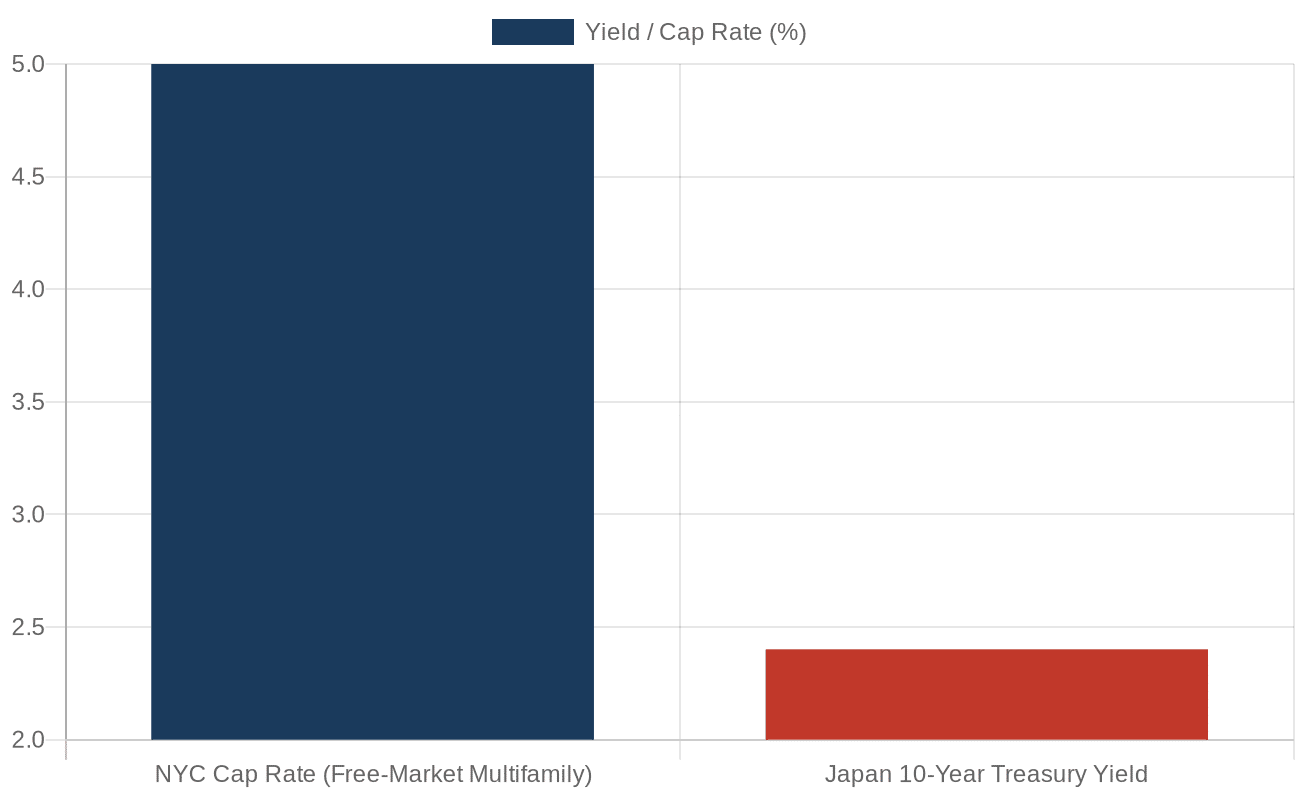
New York’s multifamily market delivers fundamentals that are difficult to replicate anywhere else in the developed world. The vacancy rate for NYC multifamily sits at approximately 3.0%, with annual rent growth running at 7.0% in 2025, according to Matthews Real Estate. Free-market cap rates in the city’s multifamily market are running approximately 5.0% to 5.4% — a spread of several hundred basis points above what Japanese institutional investors can earn at home. The structural undersupply of housing in New York City, driven by restrictive zoning and limited developable land in the five boroughs, creates a supply-demand imbalance that protects values through economic cycles.
What Japanese Investors Specifically Want
Japanese buyers are targeting market-rate, relatively clean multifamily assets — buildings free of rent-stabilized complications, active HPD violations, or deferred maintenance — in the $5M to $15M range. There is a specific and underappreciated tax rationale at work. Under Japan’s domestic tax code, wood-frame buildings carry a useful life of just 22 years. When a Japanese buyer acquires a pre-war NYC walk-up, they can depreciate the building against Japanese income rapidly, creating a significant tax benefit that effectively subsidizes the acquisition cost. This is why the Friends building in the West Village and other older wood-frame walk-ups are so appealing to Tokyo-based buyers.
The Local Knowledge Gap: What Foreign Investors Don’t Know Can Cost Them
NYC’s regulatory environment is extraordinary in its complexity. Local Law 97 carbon emission penalties start at $268 per metric ton of CO2 over the building’s threshold, with potential annual fines reaching hundreds of thousands of dollars for a mismanaged mid-sized building. FISP facade inspections apply to every building taller than six stories on a rotating DOB cycle. Rent stabilization covers approximately one million NYC apartments. The 32BJ SEIU union contract governs building service workers in union properties. HPD violations track every deferred maintenance issue and create legal exposure. Operators who have been managing NYC buildings for twenty-plus years bring a form of institutional memory that no amount of satellite data or research subscription can replicate — they know which neighborhoods are inflecting, which building systems are about to fail, and which compliance deadlines are coming before the city sends the first notice.
The Owner-Operator Model: Why It Matters for International Capital
The most important distinction for international investors is not between management companies — it is between vendors and partners. Management firms that co-invest their own capital alongside client capital are a different category entirely. They are not optimizing for fee income. They are optimizing for the same thing you are: asset appreciation, stable income, and long-term value creation. That alignment of interests is worth more than any contract clause. What a true turnkey partner provides: acquisition intelligence, capital structure support, value-add renovation expertise, day-to-day operations and compliance, leasing and tenant placement, and continuous local market intelligence about where values are moving and which micro-markets are outperforming.
The Track Record Question
Foreign capital deserves the same quality of local partnership that the most sophisticated domestic family offices have been building for decades. When evaluating a local partner, the critical questions are: Have they operated through multiple NYC cycles? Do they have their own capital at risk in this market? Do they understand compliance at the systems level, not just the checklist level? Do they have access to leasing and capital through their own organization? Can they tell you what a building is worth in three years, not just what it costs today?
Ready to Discuss How Camelot Can Help?
Ready to discuss how Camelot can be your local owner-operator partner in New York City? Schedule a meeting — email dgoldoff@camelot.nyc or call (212) 206-9939.
Sources
- The Real Deal, “Japanese investors rush to buy NYC multifamily,” April 29, 2026.
- The Real Deal, “Japanese capital floods NYC multifamily market,” May 2, 2026.
- CBRE, “H2 2024 Global Real Estate Capital Flows,” 2024.
- Invesco, “Cross-Border Capital Investment in U.S. Commercial Real Estate,” July 2025.
- Ariel Property Advisors, “Inside the Surge: Why Free-Market Multifamily Is Winning in New York City,” April 28, 2025.
- Matthews Real Estate Investment Services, “Top 10 Multifamily Markets in 2026,” 2025.
- JPMorgan Commercial Term Lending, “New York Multifamily Market Outlook,” 2026.
Camelot Property Management
Need help with this topic?
Ask Merlin, Camelot's AI assistant, or schedule a free 30-minute consultation with our team.
Merlin is the yellow chat button in the bottom-right corner. On this page, Merlin starts with the building questions and asks for contact info only after the intake is complete.

Recent Comments